Choosing an industrial burner involves more than selecting the correct fuel type and heating capacity. The burner control system also plays an important role in temperature stability, operating flexibility, fuel consumption, and long-term maintenance.
Three commonly used combustion control methods are single-stage, two-stage, and modulating control.
Each system regulates burner output differently and is suited to different industrial heating conditions.
This article compares their operating principles, advantages, limitations, and typical applications to help boiler manufacturers, plant engineers, and industrial buyers select a suitable burner configuration.
1. What Is Burner Firing Control?
Burner firing control determines how the burner adjusts its heat input in response to the heating system's requirements.
Industrial boilers, furnaces, and dryers do not always operate at maximum capacity. Their heating demand may change according to production schedules, process conditions, or environmental factors.
A suitable control system helps the burner respond to these changes while maintaining safe and stable combustion.
The three common control methods differ primarily in how many firing levels they can provide.
2. Single-Stage Burners: Simple and Reliable Operation
A single-stage burner, also known as an on/off burner, operates at one preset firing level while running.
When the heating system requires heat, the burner starts and operates at its configured firing rate. Once the temperature or pressure reaches the specified control setpoint, the burner shuts down.
Main Advantages
Simple operating principle
Relatively straightforward control configuration
Lower initial equipment complexity
Suitable for applications with limited load variation
Generally easier control-system maintenance
Limitations
Because a single-stage burner cannot reduce its firing rate while operating, it may cycle frequently when heating demand is significantly lower than its output.
This can be a disadvantage in systems with rapidly changing or consistently low heating loads.
Typical Applications
Single-stage burners are often considered for:
Small industrial boilers
Hot-water heating equipment
Small industrial ovens
Heating systems with relatively predictable loads
For applications where heating demand remains reasonably consistent, a correctly sized single-stage burner can be a practical and economical solution.
3. Two-Stage Burners: Greater Flexibility for Changing Loads
A two-stage burner operates at two defined firing levels, commonly referred to as low fire and high fire.
During operation, the burner can switch between these levels according to the heating system's demand.
When greater heat input is required, the burner operates at high fire. When demand decreases, it can operate at low fire rather than shutting down immediately.
The exact switching sequence depends on the burner controller and system design.
Main Advantages
Better adaptation to moderate load variation
Potentially fewer start-stop cycles
Improved control flexibility compared with single-stage operation
Suitable for many industrial boiler applications
A balance between equipment complexity and operational capability
Limitations
A two-stage burner still has only two firing levels. It cannot continuously match every intermediate heating demand.
If the required load falls below the minimum firing level, the burner may still need to cycle on and off.
Typical Applications
Two-stage burners are commonly used in:
Steam boilers
Industrial hot-water boilers
Drying equipment
Food processing heating systems
Industrial furnaces with moderate load variation
For many industrial heating projects, two-stage control provides a practical compromise between simplicity and flexibility.
4. Modulating Burners: Continuous Adjustment for Variable Heat Demand
A modulating burner adjusts its firing rate within a specified operating range rather than operating at only one or two fixed levels.
The burner control system responds to a process signal, such as boiler pressure or temperature, and adjusts fuel and combustion air accordingly.
Depending on the equipment design, modulation may be achieved through mechanical linkage, electronic positioning, or other approved control arrangements.
Main Advantages
More precise response to changing heating demand
Improved temperature or pressure stability
Potential reduction in unnecessary burner cycling
Greater flexibility for variable industrial loads
Potential improvement in overall operating efficiency when properly configured
Limitations
Modulating burners generally require more sophisticated control components and commissioning procedures.
Their performance also depends on correct burner sizing, suitable fuel supply, and proper air-fuel adjustment throughout the operating range.
Modulating control does not automatically guarantee lower fuel consumption in every application.
Typical Applications
Modulating burners are frequently considered for:
Industrial steam boilers with variable demand
Large hot-water heating systems
Thermal oil heaters
Continuous industrial production lines
Process heating equipment requiring stable temperature control
Where heating demand changes frequently, a properly selected modulating burner may provide better operating flexibility.
5. Comparison of Three Burner Control Methods
| Feature | Single-Stage | Two-Stage | Modulating |
|---|---|---|---|
| Firing Control | One fixed level | Low and high levels | Adjustable firing range |
| Load Adaptability | Limited | Moderate | High within rated range |
| Control Complexity | Low | Medium | Higher |
| Temperature Stability | Application-dependent | Generally improved | Potentially more precise |
| Cycling Frequency | Can be higher | Can be reduced | Can be reduced further |
| Initial Cost | Generally lower | Moderate | Generally higher |
| Typical Application | Stable heating loads | Moderate load variation | Variable heating demand |
The table provides a general comparison. Actual performance depends on burner design, operating conditions, and system integration.
6. Understanding Burner Turndown Ratio
An important parameter when comparing industrial burner control systems is the turndown ratio.
The turndown ratio describes the relationship between the burner's maximum firing rate and its minimum stable firing rate.
It is calculated as:
Turndown Ratio = Maximum Firing Rate ÷ Minimum Stable Firing Rate
For example, consider a burner with a maximum firing rate of 1,000 kW and a minimum stable firing rate of 250 kW.
Its turndown ratio is:
1,000 ÷ 250 = 4:1
This means the burner can operate within a verified firing range from 250 kW to 1,000 kW.
A wider turndown range can be beneficial for systems with significant load variation.
However, buyers should not assume that every modulating burner has the same turndown ratio.
The available range must be confirmed using the manufacturer's technical specifications and operating curves.
7. How to Choose the Right Burner Control System
Consider Your Heating Load
The first step is to understand how much the heating demand changes during normal operation.
For relatively stable loads, single-stage control may be sufficient.
For moderate variations, two-stage control may offer additional flexibility.
For continuously changing loads, modulating control may be more appropriate.
Evaluate Temperature or Pressure Requirements
Some industrial processes require tighter temperature or pressure control than others.
For example, continuous manufacturing processes may benefit from smoother heat input adjustments.
The control method should be selected according to the actual process requirements rather than equipment complexity alone.
Compare Initial Investment and Operating Costs
A more advanced burner control system may involve a higher initial investment.
However, operating costs depend on several factors, including:
Annual operating hours
Fuel consumption
Burner cycling frequency
Maintenance requirements
Heating load variation
Combustion efficiency
A complete evaluation should consider the total cost of ownership rather than purchase price alone.
Check System Compatibility
The selected burner must also match the existing heating equipment.
Important technical information includes:
Boiler or furnace capacity
Combustion chamber dimensions
Chamber back pressure
Fuel type and available pressure
Electrical supply
Control system interface
Required emissions performance
Final burner selection should be verified against the manufacturer's technical data and operating limits.
8. Industrial Burner Solutions from BNTET
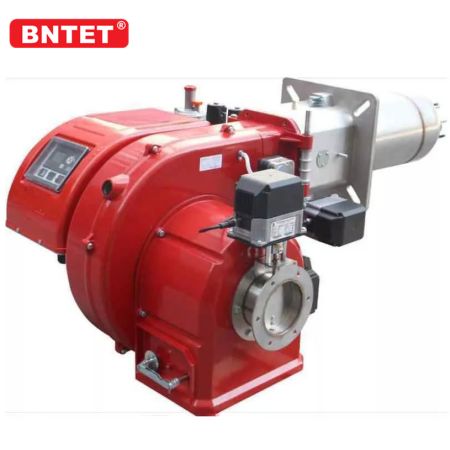
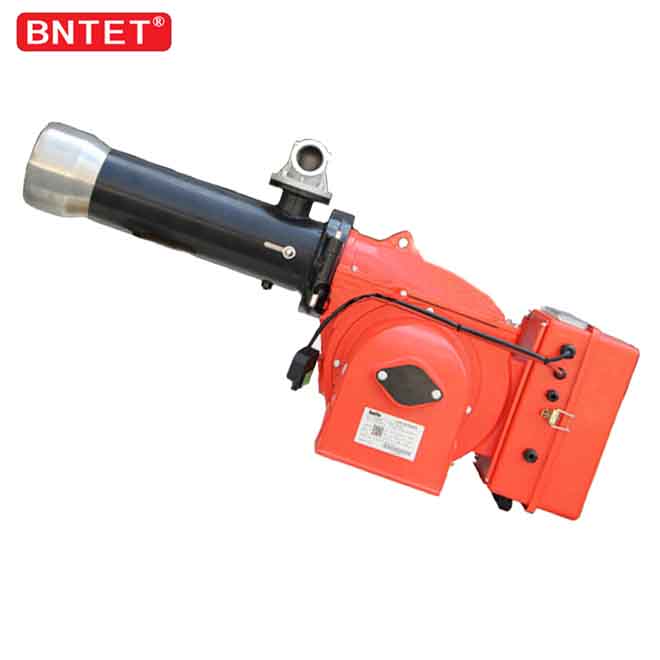
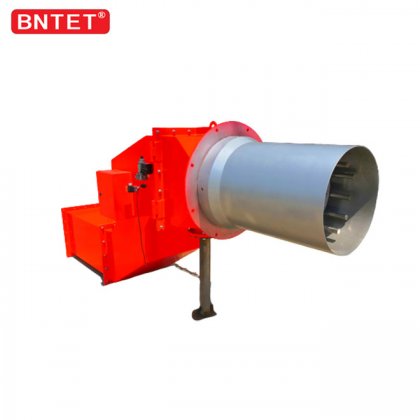
BNTET manufactures and supplies industrial burners for boilers, furnaces, dryers, and other thermal processing applications.
Our gas burner product range includes configurations designed for different heating capacities and control requirements.
Depending on the model, available control arrangements include single-stage, two-stage, and modulating operation.
BNTET also supports application-specific burner selection and configuration.
For customers planning new installations or replacing existing burners, our technical team can review the operating requirements and recommend suitable equipment options.
Whether the project involves a compact heating system or a larger industrial boiler, selecting the correct firing control method is an important part of achieving reliable operation.
9. Frequently Asked Questions
What is the main difference between single-stage and two-stage burners?
A single-stage burner operates at one firing level, while a two-stage burner can switch between low and high firing levels according to heating demand.
Are modulating burners more energy-efficient?
Modulating burners may improve operating efficiency in applications with variable heating loads by reducing unnecessary cycling and improving load matching. Actual savings depend on the complete heating system.
Is a two-stage burner suitable for an industrial steam boiler?
Yes. Two-stage burners are used in many industrial steam boiler applications. Suitability depends on boiler capacity, operating load, chamber conditions, and control requirements.
Can a single-stage burner be replaced with a modulating burner?
A replacement may be possible, but compatibility must be evaluated. The new burner must match the boiler, combustion chamber, fuel supply, electrical system, and safety controls.
Which burner control method is best for continuous operation?
There is no universal answer. Continuous processes with variable heat demand may benefit from modulating control, while stable-load applications may operate effectively with simpler systems.
Conclusion
Single-stage, two-stage, and modulating burners offer different levels of control flexibility.
Single-stage burners provide a simple solution for relatively stable heating requirements. Two-stage burners offer improved adaptability to changing loads, while modulating burners allow more continuous adjustment of heat input.
The most suitable choice depends on the application's load profile, operating requirements, equipment compatibility, and investment considerations.
Need help selecting an industrial burner?
Contact BNTET with your project specifications to discuss suitable burner models and control configurations.
Website: https://www.bntet-burner.com/
Email: info@bntet.com
References
U.S. Department of Energy. Upgrade Boilers with Energy-Efficient Burners.
https://www1.eere.energy.gov/manufacturing/tech_assistance/pdfs/steam24_burners.pdfU.S. Department of Energy. Minimize Boiler Short Cycling Losses.
https://www.energy.gov/eere/amo/articles/minimize-boiler-short-cycling-lossesU.S. Environmental Protection Agency. Boiler Tune-up Guide.
https://www.epa.gov/sites/default/files/2021-03/documents/tune-up_guide_revised_0.pdf