When selecting an industrial burner, buyers often start with one question: Can it provide enough heat at maximum production?
A second question deserves equal attention: How low can it fire when demand falls?
A burner may meet a plant's peak requirement yet be poorly matched to its quieter operating periods. Understanding burner turndown ratio helps buyers assess both ends of the operating range before choosing equipment.
What Is Burner Turndown Ratio?
Burner turndown ratio is the maximum firing rate divided by the minimum stable firing rate, using the same rating basis and specified operating conditions.
For example, a burner operating from 200 kW to 1,000 kW has a turndown ratio of:
1,000 ÷ 200 = 5:1
This means its minimum firing rate is 20% of its maximum. It does not mean the burner is 20% efficient at low fire, and it does not describe the useful heat delivered by the boiler.
| Illustrative turndown ratio | Maximum fuel input | Minimum fuel input |
|---|---|---|
| 3:1 | 1,000 kW | Approximately 333 kW |
| 5:1 | 1,000 kW | 200 kW |
| 10:1 | 1,000 kW | 100 kW |
These are calculation examples, not specifications for BNTET models.
Why Does Minimum Firing Rate Matter?
Consider a plant that needs high heat input during production startup but much less heat while holding temperature or supplying a reduced steam load.
If demand drops below the burner's minimum firing rate, the system may need to stop firing and restart when temperature or pressure falls. The actual cycling pattern also depends on system storage, control settings and equipment design.
For boilers, frequent short cycles can increase the relative effect of fixed losses and introduce repeated purge-related heat losses. The U.S. Department of Energy identifies better burner turndown as one approach to reducing short cycling [1].
The practical goal is to match both the maximum and minimum firing rates to the plant's operating needs.
A Simple Low-Load Comparison
Assume a process needs fuel input equivalent to 1,000 kW at peak operation and 150 kW during a sustained low-load period.
| Burner option | Available input range | Can it continuously match 150 kW? |
|---|---|---|
| Option A: 5:1 | 200–1,000 kW | No; demand is below minimum fire |
| Option B: 10:1 | 100–1,000 kW | Potentially, if approved for the installation |
Option B provides a closer operating match in this example. However, the stated range must be achievable with the actual fuel, combustion chamber and emissions requirements.
This comparison assumes a continuous low-load requirement. Brief changes in demand may be absorbed by the system's thermal storage.
Does a Higher Turndown Ratio Always Save More Fuel?
A higher ratio can help, but it is not a fuel-saving guarantee.
Actual performance depends on how much time the plant spends at low load, combustion adjustment, excess air, boiler heat-transfer characteristics, purge requirements and control behavior.
The minimum firing rate is especially useful when compared with operating records. If the plant rarely runs below 40% load, a much deeper modulation range may offer limited additional value. If it spends hours at 15% load, minimum-fire capability becomes a more significant selection factor.
Ask for the usable operating range under your project conditions, rather than comparing headline ratios alone.
Modulating Capability Must Include the Right Controls
A modulating burner adjusts firing rate between defined limits in response to demand. The installation also needs a compatible controller, suitable temperature or pressure feedback, and coordinated fuel and air adjustment.
A burner described as “progressive two-stage” may require an additional modulation controller to provide automatic continuous load control. Manufacturer documentation demonstrates this distinction [2].
When reviewing a quotation, confirm whether the proposed package includes the required controller, sensors and control interfaces. Do not assume that a servo motor alone provides the complete modulation function.
What Information Should You Send for Selection?
Prepare a short operating profile before requesting a burner recommendation.
| Project information | What to provide |
|---|---|
| Equipment | Boiler, thermal oil heater, dryer or furnace |
| Heat requirement | Maximum, normal and minimum demand; identify whether values are fuel input or useful output |
| Operating pattern | Hours per day and time spent at low load |
| Fuel | Fuel type, composition or heating value where available, and supply pressure |
| Existing operation | Start-stop frequency and temperature or pressure trends |
| Equipment interface | Combustion chamber information, backpressure and mounting details |
| Controls and emissions | Required signals, control accuracy and applicable emissions limits |
If only useful heat output is known, the corresponding fuel input must be established using a suitable equipment-efficiency basis.
Discuss Your Burner Operating Range with BNTET
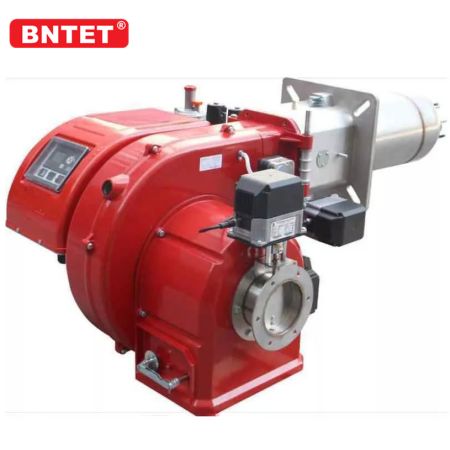
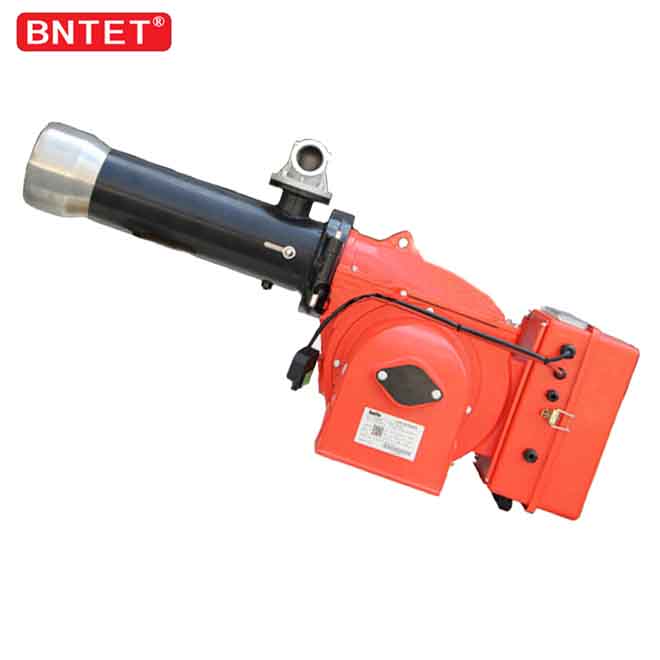
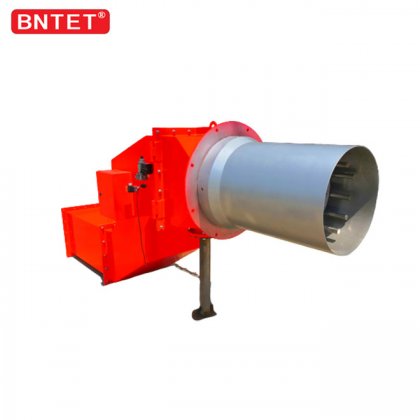
BNTET's industrial gas burner range includes different control configurations. The appropriate model and usable firing range should be confirmed against the application.
Send your equipment information, fuel conditions and maximum-to-minimum heat demand through our Contact Us page.
Include your lowest sustained operating load alongside your peak demand so both can be considered during selection.
References
U.S. Department of Energy. Minimize Boiler Short Cycling Losses — Steam Tip Sheet #16.
Baltur. BTG ME: Progressive/Modulating Two-Stage Gas Burners with Electronic Cam. Cited for the distinction between progressive operation and modulation with an additional controller; its specifications do not describe BNTET products.