Low-NOx Burner Retrofit for Gas-Fired Boilers: A Practical Compliance Guide
Direct answer: for most existing industrial gas-fired boilers, a staged-combustion burner plus moderate flue gas recirculation (FGR) is the most mature, lowest-risk route to compliance. Lean premixed combustion cuts NOx most - about 85-90% in reviewed studies - but suits new units or deep retrofits, not drop-in replacements. [1]
Why gas burners produce NOx
Natural gas carries almost no fuel-bound nitrogen, so most NOx comes from the combustion air:
Thermal NOx: nitrogen and oxygen form nitric oxide at high flame temperature, rising steeply with peak temperature and residence time. Controls therefore either cool the flame (FGR, staging, premixing) or shorten hot residence time.
Prompt NOx: fast flame-front reactions, strongest in locally fuel-rich zones.
Fuel NOx: from nitrogen bound in the fuel - negligible for pipeline gas, significant for oil and waste-derived liquids.
Glarborg et al. review these pathways in Progress in Energy and Combustion Science. [2]
What the rules require
EU: Directive (EU) 2015/2193 covers plants from 1 MW to 50 MW. Plants running before 20 December 2018 are "existing"; later ones are "new" and must meet the Annex II limits. Existing plants phase in by size - above 5 MW from 1 January 2025, 5 MW and below from 1 January 2030 - and units running 500 hours or less per year may be exempted. [3] Regulation (EU) No 813/2013 limits gas-fired space-heating boilers to 56 mg/kWh of fuel input. [1]
US: boilers firing more than 10 MMBtu/h fall under the New Source Performance Standards, 40 CFR Part 60 Subparts Db and Dc, covering NOx, SO2 and particulate matter. [4]
Units matter: EU concentrations are dry at 273.15 K and 101.3 kPa, with 3% reference O2 for gas-fired boilers and 15% for turbines and engines. [1] A burner quoted at 30 mg/Nm3 at 3% O2 is not comparable with one quoted at 15% O2. Ask for reference oxygen, dry or wet basis and standard state.
Which retrofit fits
Staged combustion: typically 15-30%, up to 55% in a 110 MW utility boiler test; CO and heat-flux problems if over-staged.
External FGR: usually 10-20% of flue gas; needs duct space and fan reserve.
Lean premixed: about 85-90%; best for new or deeply retrofitted small and medium boilers.
Humidification with waste-heat recovery: about 53-82%; site-specific, needing water treatment.
Figures are relative to each source's baseline. [1] Control alone also counts: on a 110 MW gas-fired boiler, cutting flue gas O2 from 2.2% to 0.6% cut NOx by 33% without changing the burner. [1]
One caution: in the EU, a plant whose burner is replaced is widely treated as "new" rather than "existing", and must meet the stricter limits. [5]
Specification checklist
State the limit in full: value, reference O2, dry or wet, standard state, averaging period.
Give the load profile, not only the rating; turndown decides performance at low load.
Provide furnace geometry: flame length, volume and heat-flux limits.
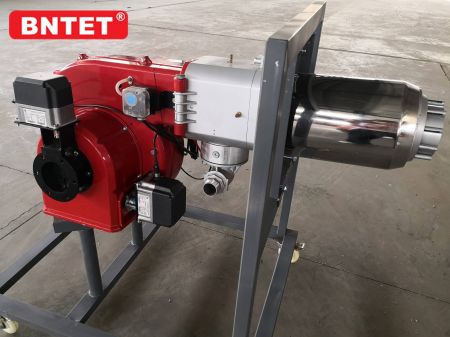
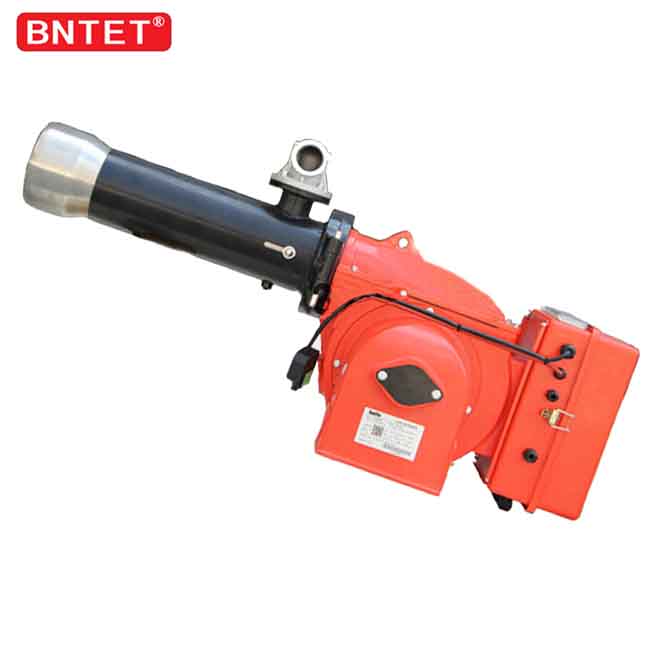
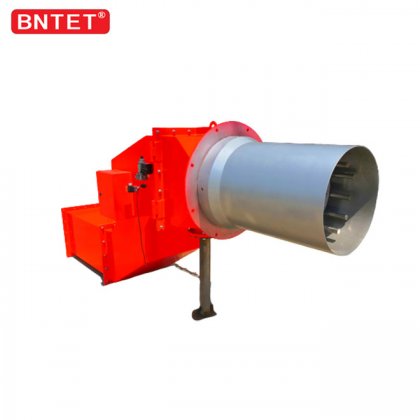
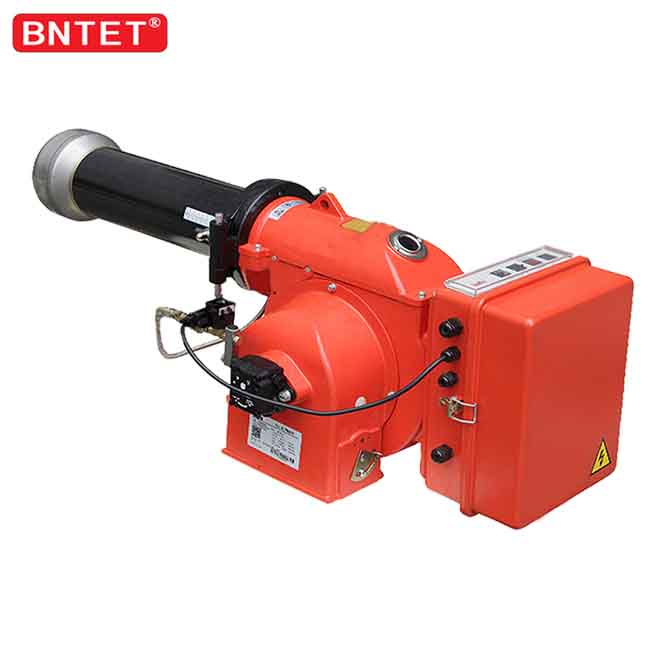
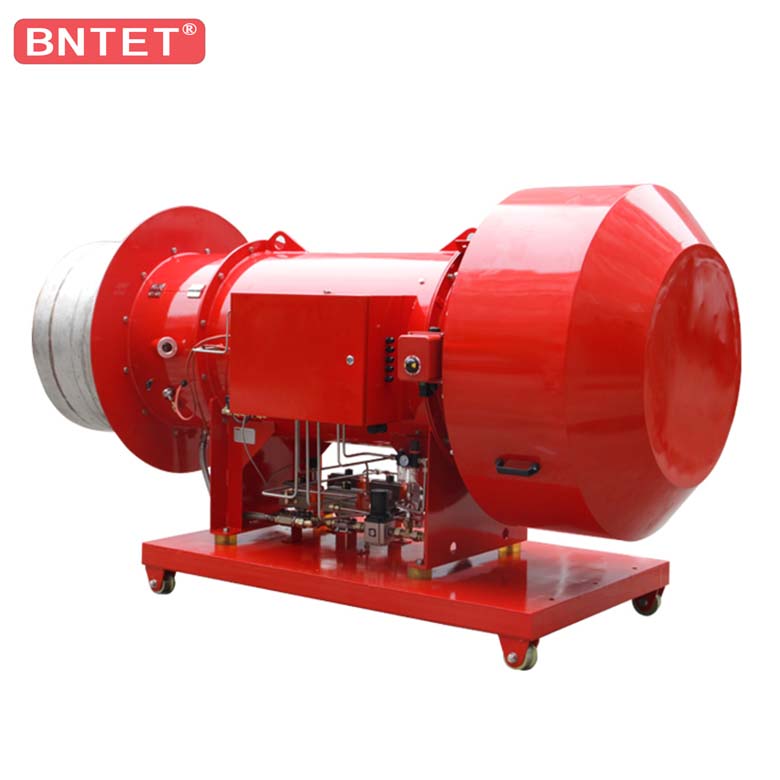
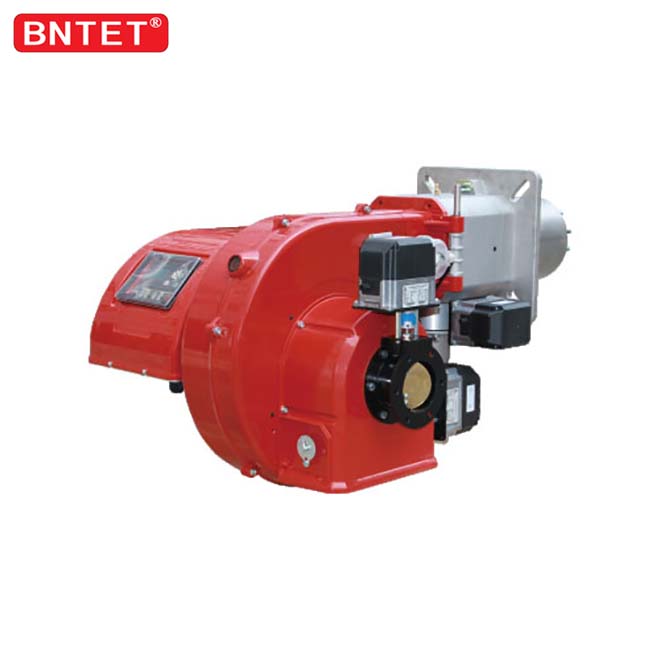
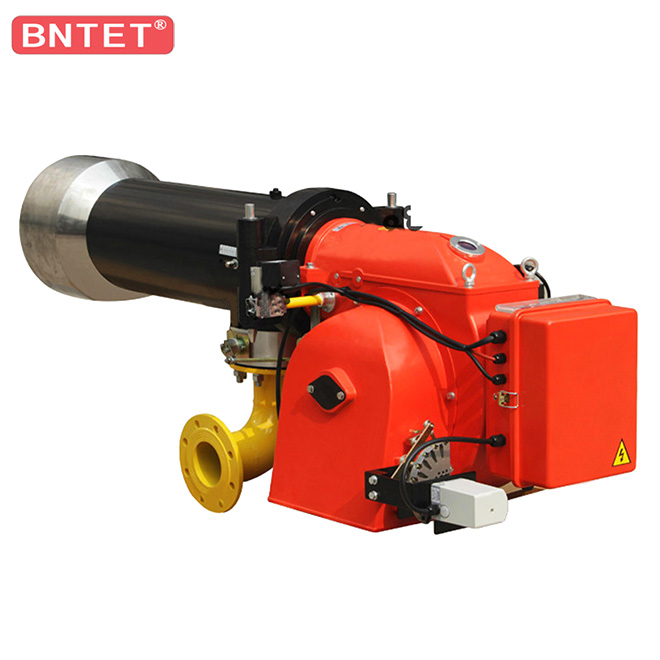
Supply the real fuel analysis. A supplier such as BNTET, which builds industrial gas, light oil and methanol burners, needs actual fuel data, not a category name.
Agree the measurement plan before delivery: the regulator reads the test report, not the datasheet.
FAQ
Is FGR worth the fan power? Usually yes within a 10-20% range, though fan power offsets part of the fuel saving. [1]
Can ultra-low NOx be reached with a burner change alone? Not reliably; the best results combine the burner with air control, FGR or heat recovery. [1]
Does low NOx always mean high CO? No, but excessive staging and very high FGR both raise CO. Ask for CO data at minimum load. [1]
The bottom line
Compliance is won in the specification, not the flame. Stage the combustion, apply moderate FGR, control excess air, and define the limit before comparing quotations. That is the discipline BNTET applies when specifying low-NOx burners for industrial gas, light oil and methanol duty.
References (foreign sources)
[1] Liu, T., Zhang, Q., An, Z., Huang, H., Cheng, X., Zhang, C., Lu, X. (2026). Research and Application of Low-NOx Combustion Technologies for Natural-Gas-Fired Boilers: A Comprehensive Review. Energies, 19(16), 3707. https://doi.org/10.3390/en19163707
[2] Glarborg, P., Miller, J. A., Ruscic, B., Klippenstein, S. J. (2018). Modeling nitrogen chemistry in combustion. Progress in Energy and Combustion Science, 67, 31-68. https://doi.org/10.1016/j.pecs.2018.01.002
[3] European Parliament and Council (2015). Directive (EU) 2015/2193 on the limitation of emissions of certain pollutants into the air from medium combustion plants. Official Journal L 313, 28.11.2015. https://eur-lex.europa.eu/legal-content/EN/TXT/?uri=CELEX:32015L2193
[4] United States Environmental Protection Agency. Industrial-Commercial-Institutional Steam Generating Units: New Source Performance Standards (40 CFR Part 60 Subparts Db and Dc). https://www.epa.gov/stationary-sources-air-pollution/industrial-commercial-institutional-steam-generating-units-new
[5] Riello (2024). The Medium Combustion Plant Directive (MCPD) 2015/2193 is under implementation. https://www.riello.com/international/news/the-medium-combustion-plant-directive
--- CMS entry fields (do NOT paste into the article body) ---
Title: Low-NOx Burner Retrofit: Meet EU and US NOx Limits Meta description: A concise guide to low-NOx burner retrofits for gas-fired boilers: EU MCPD and US EPA limits, technology comparison, and a specification checklist. Slug: low-nox-burner-retrofit-gas-boilers Primary keyword: low-NOx burner retrofit Secondary keywords: NOx emission limits gas boiler, flue gas recirculation burner, MCPD compliance burner Internal links: gas burner, low-NOx burner, light oil burner, contact page